

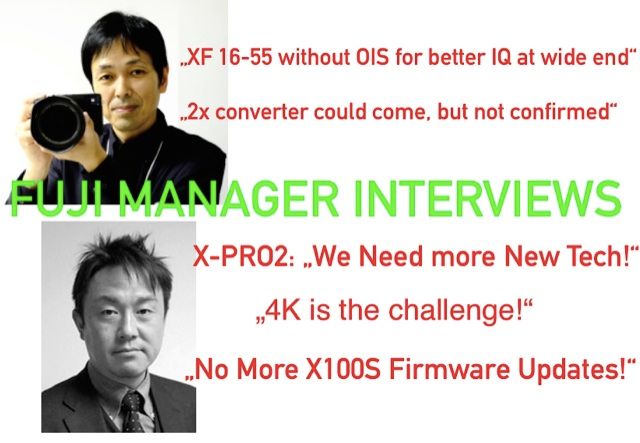
4K:”Currently, our
X-Trans CMOS II [sensor] cannot realize 4K videos because it has a
smaller number of pixels, like 16-megapixel. Also, if we [want to]
realize 4K video, the sensor itself should have much faster reading
speed.”
X100S firmware: “While
we have provided firmware upgrades for the X100S many times, now we
have the X100T, we’re finished, no firmware upgrades [for the X100S]
anymore.”
Frankly disappointing, if true. I can understand that they hold on
with the FW release, since the X100T is relatively new, and a new X100S
firmware would probably influence negatively the sales… but on the long
term Fuji must update the X100S. X100S owners are a VERY important part
for Fuji’s success, so they deserve an update.
X-PRO2: “But if we
launched an X-Pro, we’d need more new technologies, and we’re still
developing and investigating. Especially the new devices like the
processor or sensor, we’re still preparing.”
There is more to read at imaging-resource,
for example about the gyro sensor used for the OIS in the 50-140. A
technology missing in the 16-55… and in another interview at fujifilm-blog
another manager (Mr Soga, the man responsible for the lens roadmap)
explains the true reason for the lack of OIS: it’s not about size, it’s
not about costs… it’s about IQ at the wide end (16mm)! He says:
“OIS needs to move
the lens inside to compensate for camera shake and as a result can cause
loss of resolution in the edges of the image. In long zoom lens such as
the XF50-140mmF2.8, the angle of view is narrow enough to not show this
negative effect of OIS in the edges. However, the angle of view of the
XF16-55mm, when set to the widest setting, is large enough for OIS to
affect resolution at the edge of the image. Considering this trade-off,
because we wanted this zoom lens to start wide at 16mm and F2.8, and we
wanted to best edge-to-edge quality throughout the entire zoom range, we
decided to not employ OIS.”
Mr. Soga also confirms that teh XF 35mmF2 will have faster focussing and “we may create a 2x converter in the future although this has not been confirmed.”Source : fujirumors


